


Introduction
Selecting a silicone rubber heater for industrial use requires more than matching a power rating to a surface. The right choice depends on what must be heated, how quickly the target temperature must be reached, and the conditions around it, including insulation, moisture, vibration, and available space. A heater that works well on a small enclosure may fail on a drum, pipeline, or control panel if heat loss, temperature uniformity, or mounting needs are overlooked. This article explains the key factors that shape heater selection so you can evaluate specifications with confidence and choose a solution suited to the application.
How to frame silicone rubber heater selection
Working with thermal management systems reveals that choosing a flexible heater is not just about picking a random wattage out of a catalog. You must start by rigorously framing the exact problem you are trying to solve before even looking at a specification sheet.
Define the heating problem
Are you trying to prevent condensation in an outdoor control panel, maintain a heavy fluid’s viscosity in cold weather, or cure an aerospace composite material? Always calculate the required wattage based on the specific heat of the material, the mass being heated, and the desired heat-up time. For example, heating a 50-gallon steel drum of oil from 20°C to 80°C in two hours requires vastly different thermal dynamics than keeping a small 500ml medical fluid bag at a steady 37°C. You also must factor in environmental heat loss. It is recommended to add a 20% to 30% safety margin to your theoretical wattage to account for uninsulated surfaces and convective losses in drafty areas.
Identify key operating conditions
Once you know what you are heating, look closely at the operating environment. Will the heater be exposed to harsh chemicals, pooling moisture, or extreme ambient temperatures? Standard silicone rubber handles ambient temperatures down to -60°C and safely operates up to around 232°C (450°F). However, if your application sees continuous exposure to caustic solvents or requires IP66-level washdowns, you must specify a thicker silicone build or a specialized fiberglass-reinforced over-mold. Mechanical stress is another critical factor. If the heater flexes continuously during operation, establish a minimum bend radius—often around 1.5 inches for standard wire-wound designs, or tighter for etched foil—to prevent the internal elements from fatiguing and snapping over time.
Which silicone rubber heater specifications to compare
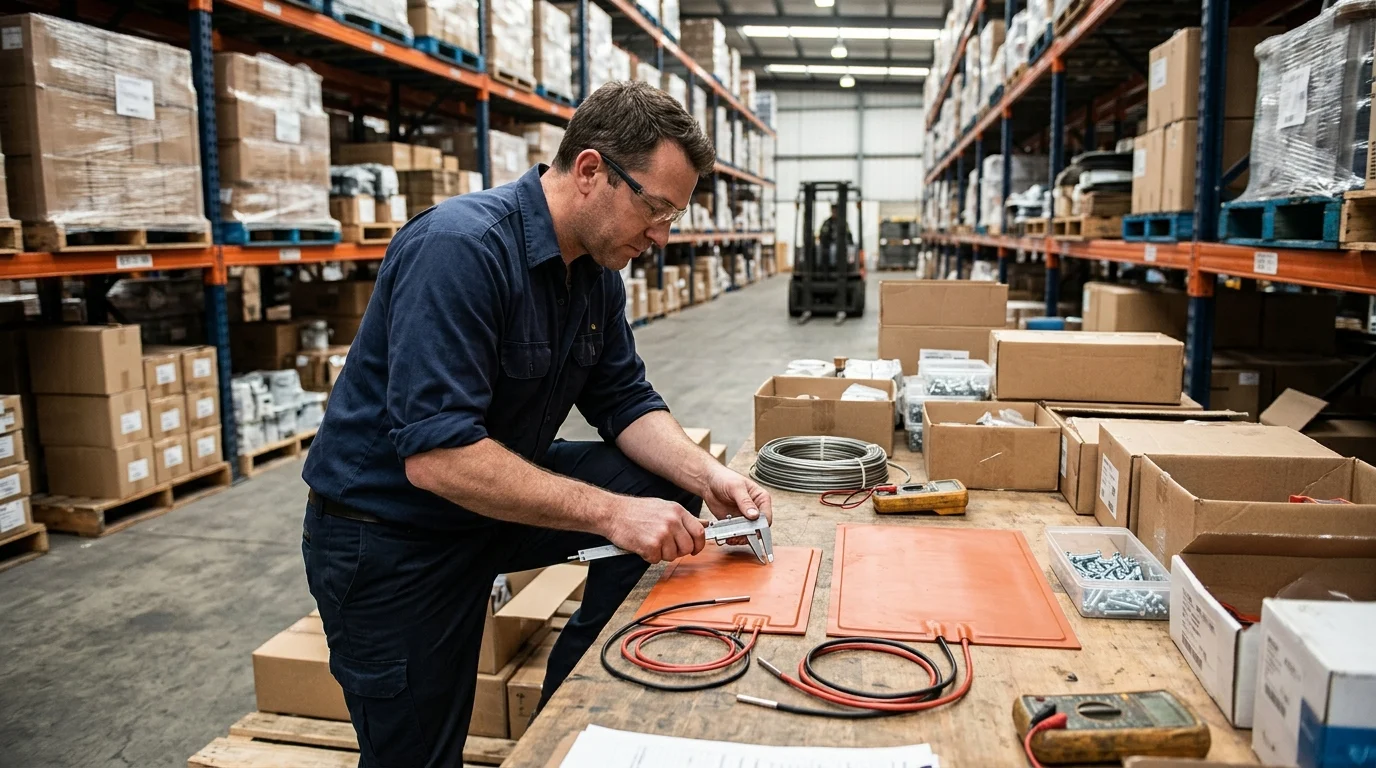
After nailing down the environment and operational purpose, dive straight into the hard specifications of the silicone heating mat. This is the phase where you balance ideal performance with actual physical and electrical constraints.
Compare power, voltage, size, and temperature
The core specifications to compare are watt density, voltage, and physical dimensions. It is strongly recommended to keep watt density below 5 W/in² (0.77 W/cm²) for applications where the heater is not perfectly mated to a heat sink, though you can push it up to 30 W/in² for highly controlled, tightly clamped setups with excellent thermal transfer. Voltages typically range from 12V or 24V DC for portable, battery-operated gear up to 120V, 240V, or even 480V AC for heavy industrial use. Use this quick reference table to compare the two main internal element types:
| Element Technology | Optimal Watt Density Range | Max Operating Temp | Minimum Bend Radius | Best Application Fit |
|---|---|---|---|---|
| Wire-Wound | 1 to 5 W/in² | 232°C (450°F) | ~1.25 inches | High flex, prototyping, thicker profiles (0.056″), small runs |
| Etched Foil | 5 to 30 W/in² | 232°C (450°F) | ~0.25 inches | Rapid heat transfer, uniform heating, thin profiles (0.030″), high volume |
Review attachment, leads, and controls
How you attach the heater is just as critical as its power rating; high-spec heaters often fail simply because they peel off the substrate. Pressure-sensitive adhesive (PSA) is incredibly convenient for flat surfaces but usually caps out around 150°C. If you are running hotter, you will need room temperature vulcanizing (RTV) silicone adhesive, direct factory vulcanization to the part, or mechanical fasteners like heavy-duty springs, lacing, or Velcro. For the electrical leads, specify Teflon or silicone-insulated wires with adequate strain relief; a 10-pound pull test without degradation is a solid baseline requirement. Finally, do not forget your thermal controls. Integrating a simple bi-metal thermostat (set to open at 100°C ±5°C) or a precise PT100 RTD sensor directly into the mat ensures you do not accidentally damage your expensive equipment.
How to evaluate suppliers, compliance, and total cost

Specifications on paper are great, but buying an Industrial heater means partnering with a reliable manufacturer. Always evaluate a supplier’s quality control processes and total lifecycle costs before signing off on a purchase order.
Check materials, testing, and certifications
Never compromise on compliance and testing. Depending on your industry, look for UL (such as UL 499 for electric heating appliances), CE, or CSA certifications. For instance, if you are building medical devices, the supplier should ideally operate under ISO 13485 standards and target a defect rate of less than 0.5%. Always ask suppliers for their dielectric strength testing data. A standard industrial silicone heater should easily withstand 1500V AC for one minute without breaking down or arcing. Additionally, verify the insulation resistance, which should be greater than 1000 Megohms when tested at 500V DC. If a vendor hesitates or cannot immediately produce these batch test reports, consider it a massive red flag.
Assess lead time, customization, and lifecycle cost
Finally, consider the bottom line and lead times. A custom heating element might cost 20% to 40% more upfront than an off-the-shelf pad, but it often saves money in the long run by reducing assembly time and preventing premature field failures. When evaluating quotes, look closely at the tooling costs, Minimum Order Quantity (MOQ), and production lead times. A solid supplier can usually turn around a custom prototype in 2 to 3 weeks, with full production runs taking 4 to 6 weeks. Calculate the total lifecycle cost by factoring in the expected lifespan—typically 5 to 10 years for a well-designed silicone heater—against the catastrophic cost of machine downtime. Paying an extra $50 or $100 per unit for an integrated sensor, custom cutouts, and superior adhesive is a worthwhile investment if it prevents a costly production line halt.
Key Takeaways
- The most important conclusions and rationale for Silicone Rubber Heater
- Specs, compliance, and risk checks worth validating before you commit
- Practical next steps and caveats readers can apply immediately
Frequently Asked Questions
How do I calculate the right wattage for a silicone rubber heater?
Start with material mass, specific heat, target temperature rise, and heat-up time, then add 20% to 30% for heat loss. Jingwei Heat can review your sizing before production.
What watt density is usually safe for industrial silicone rubber heaters?
For imperfect contact surfaces, keep it below 5 W/in². For tightly clamped, well-controlled applications with strong heat transfer, etched foil designs can go much higher.
Should I choose wire-wound or etched foil silicone rubber heaters?
Choose wire-wound for frequent flexing, thicker builds, or small runs. Choose etched foil for thinner profiles, better temperature uniformity, tighter bend radius, and higher-volume production.
Which attachment method works best for a silicone heating mat?
Use PSA for flat surfaces and temperatures up to about 150°C. For higher temperatures or tougher duty, choose RTV silicone, factory vulcanization, or mechanical fastening.
What should I confirm with a supplier before ordering a custom heater?
Check operating temperature, voltage, watt density, lead insulation, strain relief, sensor options, and testing or compliance documents. A manufacturer like Jingwei Heat should verify these details against your application.
Post time: May-08-2026