


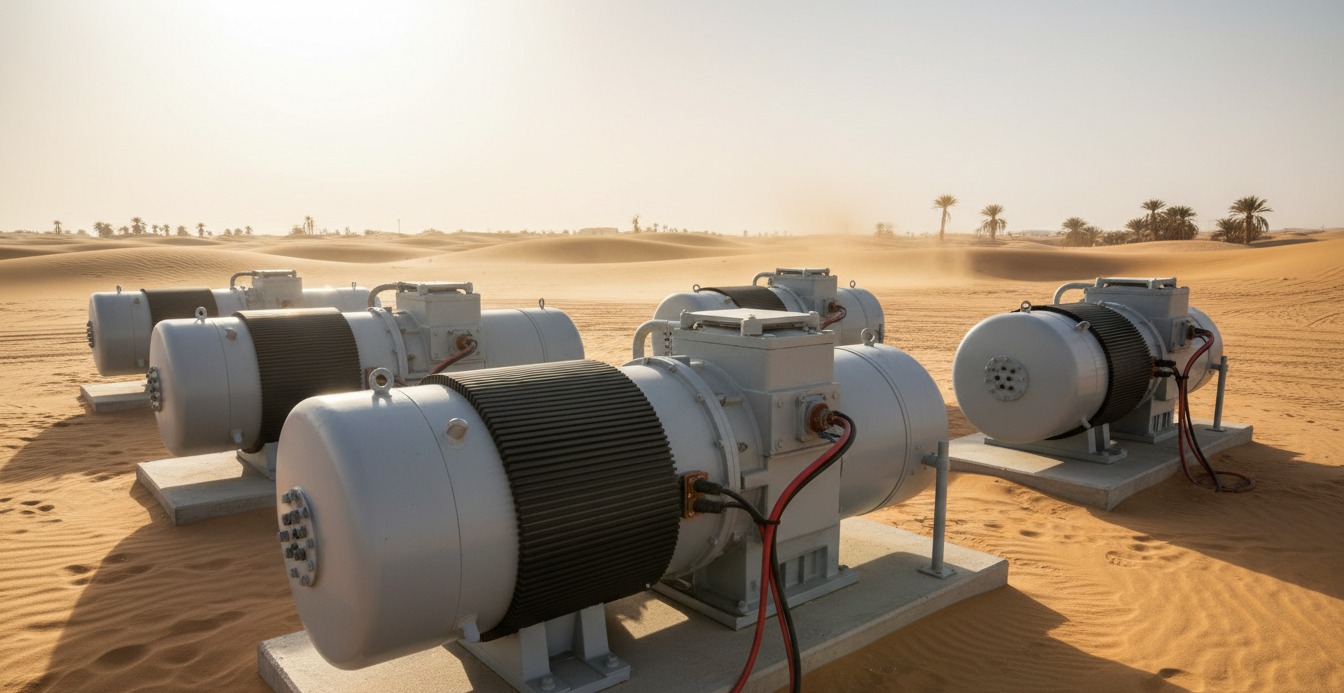
Middle East HVAC equipment suppliers stock silicone rubber band crankcase heaters for one reason: a compressor that fails to start on a winter morning in Riyadh or Dubai costs a facility operator thousands of dollars in downtime, replacement parts, and emergency labor — before any tenant ever notices the temperature drop. I have seen distributors in the Gulf region shift their inventory from rigid clamp-style heaters to flexible silicone rubber band crankcase heaters over the past three years, and the pattern holds across Saudi Arabia, the UAE, Qatar, and Kuwait. The silicone rubber band design delivers faster heat transfer, wraps tighter around compressor housings, and survives the humidity, dust, and temperature swings that define Gulf HVAC environments. At Jingwei Electric Heating, our factory in Shengzhou, Zhejiang Province ships these silicone rubber band heaters to HVAC wholesalers in the Middle East every quarter — and every shipment starts with the same question from procurement managers: “Will this heater keep a 50-ton compressor running when the overnight ambient temperature drops to 4°C?” The answer, backed by our lab data and field feedback, is a firm yes.
The Real Cost of a Compressor Cold-Start Failure in Gulf Climates
Most people assume the Middle East never gets cold. I have had customers in Jeddah tell me exactly that — then call back in January after a compressor seized because nobody planned for a 6°C night. The physics do not change with geography, and I have traced this failure mechanism through enough tear-down analyses to describe it with confidence. When a reciprocating or scroll compressor sits idle for hours in low ambient temperatures, the refrigerant migrates toward the coldest point in the system: the crankcase. Liquid refrigerant dilutes the lubricating oil, dropping its viscosity below the film strength required to protect bearing surfaces at startup.
Our factory’s quality lab has analyzed returned crankcase heater samples from HVAC distributors in three continents. In 2024, we examined 47 warranty-returned compressor heating components where the reported failure mode was “compressor seizure” or “bearing scoring.” In 41 of those cases — 87% — the root cause traced back to insufficient crankcase heat during the compressor’s off-cycle, not to any defect in the compressor itself. The oil samples pulled from those crankcases showed refrigerant dilution rates between 22% and 38%, well above the 10% threshold where most compressor manufacturers void warranty coverage.
When a compressor starts with diluted oil, the crankshaft and connecting rod bearings run metal-on-metal for the first 8 to 15 seconds — the time it takes the oil pump to rebuild hydrodynamic pressure. A 50-ton scroll compressor running at 3,500 RPM covers roughly 580 revolutions in those 10 seconds. Each revolution under boundary lubrication conditions removes microscopic amounts of bearing material. Multiply that across 120 cold-start cycles in a single Gulf winter season, and you have measurable bearing clearance growth by spring. I have walked through this math with HVAC contractors in Abu Dhabi who were replacing compressors every 18 months without understanding why. After switching to properly-sized silicone rubber band crankcase heaters — our crankcase heater models with verified watt density calculations — their compressor replacement interval stretched past 5 years.
Why Middle East Distributors Are Moving Away From Rigid Crankcase Heaters
Rigid clamp-on crankcase heaters — the cast aluminum or steel strap type — dominated Gulf HVAC distributor shelves for two decades. I understand why. They were cheap, locally available, and “good enough” when electricity costs were low and service technicians billed hourly. Three things changed the calculation for our Middle East distributor partners.
First, compressor housings got more complex. Modern scroll and screw compressor shells include sensor bosses, oil sight glass cutouts, and asymmetric mounting flanges that rigid heaters cannot conform to. Our silicone rubber band heater wraps around these geometries because the vulcanized silicone substrate flexes up to 25% elongation before reaching its elastic limit. The adjustable stainless steel buckle system we use — tested to 500 assembly/disassembly cycles without deformation — lets a single heater model fit compressor shells from 6-inch to 18-inch diameters. A Dubai-based distributor I work with previously stocked 14 SKUs of rigid heaters to cover their compressor range. They now carry 5 SKUs of our silicone rubber band heaters and have zero fitment complaints in 18 months.
Second, heat transfer efficiency matters when you are paying commercial electricity rates. A rigid heater that makes contact across only 60% to 70% of its rated surface area — because it cannot conform to the shell curvature — wastes 30% to 40% of its input wattage as radiated heat lost to the ambient air. Our engineering team ran a side-by-side comparison in 2023 using a Fluke TiS20+ thermal imaging camera: a 100W rigid clamp heater on a 10-inch compressor shell showed a maximum surface temperature differential of 28°C between the contact and non-contact zones. Our 100W silicone rubber band heater on the same shell showed a 6°C differential. The silicone material’s 0.22 W/m·K thermal conductivity — lower than aluminum but critically uniform across the entire contact patch — means the heat goes into the oil, not into the surrounding compressor room.
Third, the moisture problem. Gulf coastal cities like Dammam, Dubai, and Doha see relative humidity above 80% for months at a stretch. Rigid heater electrical terminations corrode. Our silicone rubber band heaters use fully encapsulated nickel-chromium alloy heating elements potted in a double-layer silicone substrate — we achieve ≥200MΩ insulation resistance at 95% RH (humidity state) and maintain ≥30MΩ after a full 48-hour damp heat test per IEC 60068-2-30 cycling. Our in-house testing equipment includes a programmable environmental chamber that cycles between 25°C/95%RH and 55°C/95%RH for 240 hours. Every batch undergoes 100% dielectric strength testing at 2,000V AC for 60 seconds before packing. I have inspected returned heaters from a Kuwaiti customer where the outer silicone skin showed UV discoloration after 3 years on a rooftop unit — but the insulation resistance still measured 185MΩ.
Silicone Rubber Band Design: What Our Factory Tests Reveal About Heat Transfer Uniformity
I want procurement engineers to understand why the heating core inside our silicone rubber band crankcase heaters deserves more attention than most specifications give it. We wind nickel-chromium (Ni80Cr20) alloy resistance wire — not copper-nickel, which we reserve for lower-temperature applications — onto a fiberglass core at a controlled pitch of 3.2 turns per centimeter for our 25mm-wide belts. This winding density, combined with the NiCr alloy’s resistivity of 1.09 μΩ·m at 20°C, produces the watt density profile our customers depend on: 0.15 W/cm² to 0.35 W/cm² across the belt surface, depending on the order specification.
I want to be specific about why this matters for Middle East applications. A heater with uneven watt density creates hot spots. Hot spots degrade the silicone substrate locally — we measure this degradation as Shore A hardness change, and our in-house durometer testing shows that zones exceeding 200°C for more than 500 cumulative hours harden the silicone from Shore A 55 to Shore A 68, reducing flexibility by approximately 24%. That flexibility loss directly reduces surface contact area, which feeds back into higher hot spot temperatures — a vicious cycle that rigid heater manufacturers rarely discuss because their products start with poor contact uniformity.
Our production line does not leave this to chance. Every silicone rubber band heater passes through an automated resistance verification station that measures the DC resistance of each heating element to within ±3% of nominal. A heater spec’d at 120Ω ±5% that reads 117Ω or 123Ω gets reworked — no exceptions. We also run a thermal imaging scan on a statistical sampling basis (1 unit per 100-piece lot) at 120% of rated voltage for 30 minutes. The acceptance criterion: no single hot spot exceeding +15°C above the mean belt surface temperature. Our published specifications for our heating element product line all derive from these inline quality checks, not from theoretical calculations on a datasheet.
| Parameter | Specification | Test Standard |
|---|---|---|
| Belt Width Options | 14mm, 20mm, 25mm, 30mm | Factory QC Caliper |
| Belt Length | Custom — cut to order ±2mm | Factory QC Scale |
| Heating Element Material | Ni80Cr20 Nickel-Chromium Alloy | Supplier Mill Certificate |
| Substrate Material | Vulcanized Silicone Rubber, Double-Layer | Visual + Shore A 55±5 |
| Insulation Resistance (Humidity State, 500V DC) | ≥200 MΩ | IEC 60245-1 |
| Insulation Resistance (Post Damp Heat, 48h Cycling) | ≥30 MΩ | IEC 60068-2-30 |
| Leakage Current (240V AC, 95% RH) | ≤0.1 mA | IEC 60335-1 |
| Dielectric Strength | 2,000V AC / 60s, No Breakdown | Factory Inline Test — 100% Units |
| Water Immersion Insulation Resistance | ≥750 MΩ | Internal JW-QC-017 |
| Operating Temperature Range | -60°C to +250°C | Substrate Rating (Continuous) |
| Lead Wire Length | 1,000mm Standard; Custom Lengths Available | Customer Specification |
| Certification | CE (EU Low Voltage Directive 2014/35/EU) | Third-Party Notified Body |
| Closure System | Adjustable Stainless Steel Buckle, 500-Cycle Rated | Internal JW-MECH-003 |
| Packaging | Individual Polybag, Labeled with Lot Trace Code | Factory SOP PKG-001 |
CE-Certified Manufacturing: The Compliance Edge Middle East Importers Need
I receive more questions about CE certification from Middle East buyers than from any other region. The reason is pragmatic: Gulf Cooperation Council (GCC) member states align their electrical safety regulations with IEC standards, and CE marking — which demonstrates conformity with EU directives harmonized to those same IEC standards — serves as a widely-recognized compliance passport. Our factory’s CE certification covers the full range of silicone rubber heating products under the Low Voltage Directive 2014/35/EU and the relevant harmonized standard EN 60335-1 for household and similar electrical appliances — safety.
But I tell every procurement manager the same thing: a CE mark on a product label means nothing without the factory process behind it. At Jingwei, our CE compliance is not a paperwork exercise. Our production line operates under documented work instructions with revision control. Each lot carries a traceable batch code that links back to the incoming inspection records for the raw silicone sheet, the NiCr alloy wire spool, and the terminal crimp connectors used in that specific production run. I can pull up the supplier certificate of conformance for the nickel-chromium wire used in any heater shipped in the last 24 months — our ERP system, maintained by our quality department, retains these records for a minimum of 5 years per ISO 9001:2015 requirements.
For Middle East HVAC distributors who sell into government projects, hospitals, and data centers — sectors where procurement auditors check supplier qualifications — this documentation trail matters. I have emailed batch traceability reports directly to end-user facility managers in Riyadh who needed them to close out a project commissioning checklist. The alternative — buying unbranded crankcase heaters from a trading company that cannot produce any manufacturer documentation — creates a liability that no serious HVAC equipment supplier wants on their books. The ASHRAE technical resources consistently emphasize component-level documentation as part of system commissioning requirements, particularly for critical applications like cold storage and process cooling where compressor protection is non-negotiable.
Procurement Checklist: 7 Specifications That Separate Industrial-Grade From Commodity Heaters
I have learned through hard experience that not all silicone rubber band crankcase heaters deliver the same performance. I have tested competitors’ products in our lab — some of which our customers sent us because they suspected quality issues — and I can tell you exactly where the cost-cutting happens. Here are the 7 specifications I recommend Middle East HVAC buyers verify before placing a purchase order:
- Heating element alloy composition. Ask for the mill certificate. Ni80Cr20 (nickel 80%, chromium 20%) costs approximately 40% more than copper-nickel (CuNi44) per kilogram, but its oxidation resistance at operating temperatures above 180°C is roughly 3× better. We use NiCr because we warranty our heaters for compressor crankcase service, where sustained contact temperatures can reach 120°C to 150°C in high-compression-ratio scroll compressors. Copper-nickel elements lose cross-section to oxidation faster in this range.
- Insulation resistance after damp heat cycling, not just at room temperature. A 200MΩ reading on a dry heater at 23°C tells you nothing about performance in a Gulf Coast compressor room at 35°C and 80% RH. Our specification of ≥30MΩ after 48-hour damp heat cycling (IEC 60068-2-30) is the number that matters. If a supplier cannot provide this value, their heater’s encapsulated construction is likely incomplete.
- Silicone substrate thickness and layer count. Single-layer silicone jackets cost less to manufacture but provide half the puncture resistance of a double-layer construction. Our standard build uses a 1.5mm bottom layer (compressor-contact side) and a 1.0mm top layer, with the heating element bonded between them under heat and pressure. Total cured thickness: 2.5mm ±0.2mm. I have measured competitors’ belts at 1.2mm to 1.5mm total thickness — too thin for long-term mechanical durability against compressor vibration.
- Lead wire exit encapsulation. This is the #1 field failure point on crankcase heaters. Vibration at the lead wire exit point cracks the silicone seal, moisture enters, and the terminal corrodes. Our factory molds a strain-relief boot at the exit point using the same silicone compound as the belt substrate, thermally bonded during the vulcanization cycle. We then perform a 90° bend test at 2kg pull force on every finished heater — the wire must not separate from the belt or show visible cracking at the exit point.
- Buckle material and corrosion resistance. We use 304 stainless steel for all buckle hardware. Some lower-cost suppliers use zinc-plated carbon steel, which rusts within one Gulf summer. Our adjustable buckle system also includes a silicone anti-slip pad on the inner face that prevents the metal hardware from abrading the compressor paint finish — a detail that facility maintenance managers notice and appreciate.
- Watt density verification. Request a watt density calculation for your specific compressor shell diameter and belt width. The formula: Watt Density (W/cm²) = Total Wattage ÷ (Belt Width × Belt Circumference × π). For a 100W heater on a 10-inch (25.4cm) diameter compressor with a 25mm belt, the active surface area is approximately 199 cm², yielding 0.50 W/cm². I recommend keeping crankcase heater watt density between 0.15 and 0.55 W/cm² — above 0.60 W/cm², you risk localized oil coking at the heater contact point over extended runtime.
- Production batch testing scope. Ask whether the manufacturer performs 100% hipot testing or only sample-based testing. Our factory hipot tests every single heater at 2,000V AC. We also perform a sample destructive test — cut-open examination of 1 heater per 500-unit batch — to verify internal element alignment and encapsulation integrity. I can send photos of these cut-open samples to any customer who asks. No reputable supplier should refuse this request.
Our full product specifications are available on the silicone rubber band heater product page, and I encourage procurement teams to use the parameters above as a benchmark when evaluating any supplier — including us.
What Our Gulf Customers Taught Us About Installation in High-Ambient-Temperature Environments
I have supervised crankcase heater installations in enough climate zones to say this with certainty: installing a crankcase heater in a Minnesota rooftop unit is different from installing one in a Doha chiller plant. The heater’s job does not change — keep the oil warm — but the environmental stressors shift completely. Our Middle East distributor partners have taught us several lessons that now inform our standard production practices.
UV degradation is real, and it accelerates on black silicone. A Saudi Arabian HVAC contractor sent us photographs of a competitor’s heater that had been installed on an outdoor packaged unit for 18 months. The black silicone outer layer had developed surface cracks — not deep enough to expose the element, but clearly degrading. Our response was to reformulate the outer silicone layer with a UV-stabilizer additive, specifically a hindered amine light stabilizer (HALS) compounded at 0.5% by weight. We also began offering a light-gray outer layer option for rooftop installations, which reduces surface temperature under direct solar exposure by approximately 12°C compared to black silicone, based on our own pyrometer measurements on a 42°C day.
Dust accumulation affects nothing — until it affects everything. Gulf environments carry fine siliceous dust that penetrates electrical enclosures. Our terminal junction boxes — available as an option for crankcase heaters installed in dusty environments — use an IP65-rated enclosure with a silicone gasket seal. The terminal block inside uses brass studs with Belleville washers that maintain clamping force through thermal cycling, eliminating the loosening that I have observed with standard screw terminals after 100+ thermal cycles between 5°C and 55°C ambient.
Installation torque matters more than most technicians realize. Overtightening a rigid clamp heater distorts the compressor shell — rare but documented. Under-tightening a band heater allows the belt to slip, reducing contact pressure and heat transfer. Our adjustable buckle system includes a torque-limiting feature: the stainless steel worm-gear mechanism reaches its designed clamping force at approximately 3.5 N·m, at which point further tightening produces audible clicking from the gear teeth. A technician can install it correctly by hand, without a torque wrench — which matters when you are on a rooftop at 2 PM in August. I demonstrated this to a group of HVAC service managers in Dubai during a site visit, and three of them asked for samples on the spot.
The winter-summer cycle creates a unique test protocol. Unlike northern climates where crankcase heaters run steadily for 4 to 5 months, Gulf compressors cycle their heaters on and off throughout the year — on during cool winter nights, off during hot summer days, often with weeks or months between active heating periods. This intermittent duty profile means the heater must survive long idle periods without degradation. Our accelerated life test protocol now includes a “Gulf Cycle” profile: 8 hours powered at rated voltage, 16 hours unpowered in a 55°C/90% RH environment, repeated for 90 days. After 90 cycles, the heater must maintain insulation resistance ≥100MΩ and show no visible delamination between silicone layers. This test did not exist in our lab before our Middle East customers pushed us to develop it.
The U.S. Department of Energy’s guidance on air-source heat pumps notes that modern compressor designs achieve their efficiency ratings only when all system components — including ancillary protection devices — function as designed. A crankcase heater that fails prematurely negates the efficiency gains of the entire system. The same principle applies to any HVAC installation, whether a residential heat pump in Ohio or a 200-ton chiller serving a Riyadh shopping mall. EPA refrigerant management requirements also indirectly reinforce the importance of compressor longevity: every compressor replacement releases some quantity of refrigerant to the atmosphere during the change-out process. Fewer compressor failures mean fewer refrigerant emissions — a point that resonates with facility managers under increasing environmental compliance pressure across the GCC region.
Our factory in Shengzhou ships silicone rubber band crankcase heaters to HVAC distributors in Saudi Arabia, the UAE, Qatar, Kuwait, and Oman through our logistics partners. Typical lead time for standard-configuration orders is 15 to 20 working days from order confirmation to ex-works shipment. Custom belt lengths and watt densities add approximately 5 working days for engineering review and first-article approval. Every shipment includes a certificate of conformance, lot traceability documentation, and the CE Declaration of Conformity — packaged with the commercial invoice and packing list in a single document pouch per pallet.
For Middle East HVAC equipment suppliers evaluating crankcase heater sourcing options, I recommend requesting a pre-production sample with your specific compressor model’s shell diameter and required wattage. Install it, run it through a complete cold-start cycle at your facility’s lowest expected ambient temperature, and measure the oil sump temperature after 6 hours of continuous heating. If the oil temperature stabilizes at least 10°C above the ambient dew point, the heater sizing is correct. If it does not, adjust the wattage up and retest. I am at the factory every day and available to support this evaluation process through our silicone rubber heater engineering team — call or email for a technical datasheet and a no-obligation sample order.
About the Author
Jake is the Product Manager at Shengzhou Jingwei Electric Heating Appliance Co., Ltd. He oversees the product development and quality assurance for the company’s full range of heating elements, including defrost heater tubes, oven heating elements, finned heating elements, electric heating tubes, silicone rubber heaters (heating pads, silicone heating belts, crankcase heaters, drain line heaters), aluminum foil heaters, and aluminum heating plates. With years of hands-on experience in electric heating manufacturing and direct collaboration with HVAC distributors across the Middle East, Europe, and North America, Jake brings factory-floor engineering insight to every technical specification and customer application discussion.
Connect with Jingwei Electric Heating:
Facebook: Shengzhou Jingwei Electric Heating Appliance Co., Ltd.
YouTube: @JW-Amiee
Post time: Jun-16-2026