


A procurement guide for chemical processing plant operators specifying silicone rubber heaters with integrated temperature controllers for industrial pipe preheating and freeze protection — covering watt-density selection, temperature control accuracy, ATEX/IECEx hazardous-area certification, and installation best practices.
TL;DR
- Silicone rubber heaters provide uniform heat distribution at watt densities of 0.5-2.5 W/cm² — the flexible silicone substrate conforms to pipe curvature, eliminating the air gaps that cause hot spots and burn-through with rigid band heaters.
- Integrated PID temperature controllers maintain pipe-surface temperature within 1-2°C of setpoint — essential for chemical processes where a 5°C deviation causes viscosity shifts that affect flow rates and pump loading.
- ATEX/IECEx Zone 1 or Zone 2 certification is mandatory for heaters installed in chemical plants where flammable vapors may be present — an uncertified heater is an ignition source and a regulatory non-compliance.
- Self-regulating heater cables are an alternative for simple freeze protection but cannot provide the precise temperature control that silicone rubber heaters with integrated controllers deliver for process-temperature-maintenance applications.
Why Pipe Freezing Is a Catastrophic Failure, Not a Maintenance Inconvenience
My name is Jake. I have manufactured silicone rubber heaters for industrial process applications for over a decade at Jingwei Heat, supplying chemical plants, oil refineries, water treatment facilities, and food processing operations across cold-climate regions. When a chemical process pipe freezes in subzero conditions, it is not just the production stoppage that matters. The ice expansion inside the pipe — approximately 9% volume increase — generates hydraulic pressure that can exceed the pipe’s burst rating even at moderate subzero temperatures. A 100 mm diameter Schedule 40 carbon steel pipe rated for 1,700 kPa at ambient temperature can fail at -10°C if completely ice-plugged, because the ice expansion pressure at the plug boundary can exceed 2,000 kPa. The pipe splits longitudinally; the chemical contents spill into the containment area; production stops for 3-7 days while the pipe section is replaced, the spill is remediated, and the environmental authorities are notified. The cost of a single freeze failure — including lost production, pipe repair, environmental remediation, and regulatory penalties — typically exceeds $50,000-150,000 for a mid-sized chemical plant. A silicone rubber heater system with integrated controller costs $2,000-8,000 installed. The economic justification writes itself.
Watt-Density Selection: The Specification That Determines Heater Life
| Application | Watt Density (W/cm²) | Max Sheath Temp | Typical Heater Life |
|---|---|---|---|
| Freeze protection (maintains 5-10°C) | 0.5-1.0 | 80-120°C | 15-20 years |
| Process temperature maintenance (50-80°C) | 1.0-1.5 | 150-180°C | 10-15 years |
| Process preheating (80-150°C) | 1.5-2.5 | 200-250°C | 5-10 years |
Watt density is the single specification that determines heater life. A silicone rubber heater operating at 0.5 W/cm² — equivalent to a surface temperature of approximately 60°C above ambient — will operate for 15-20 years because the silicone elastomer binder does not thermally degrade at this temperature. The same heater operated at 2.5 W/cm² reaches a surface temperature of approximately 220°C above ambient, causing the silicone binder to gradually embrittle and crack — reducing heater life to 5-10 years. For freeze-protection applications where the heater operates only during subzero conditions (typically 500-1,500 hours per year in cold-climate regions), the higher watt-density heater provides faster response time and may still achieve a 15-year service life because the cumulative thermal exposure is low. The key principle: match the watt density to the worst-case heating requirement, not the average — and if the worst case requires above 2.0 W/cm², consider installing two lower-watt-density heaters side-by-side rather than one high-watt-density heater that will fail prematurely.
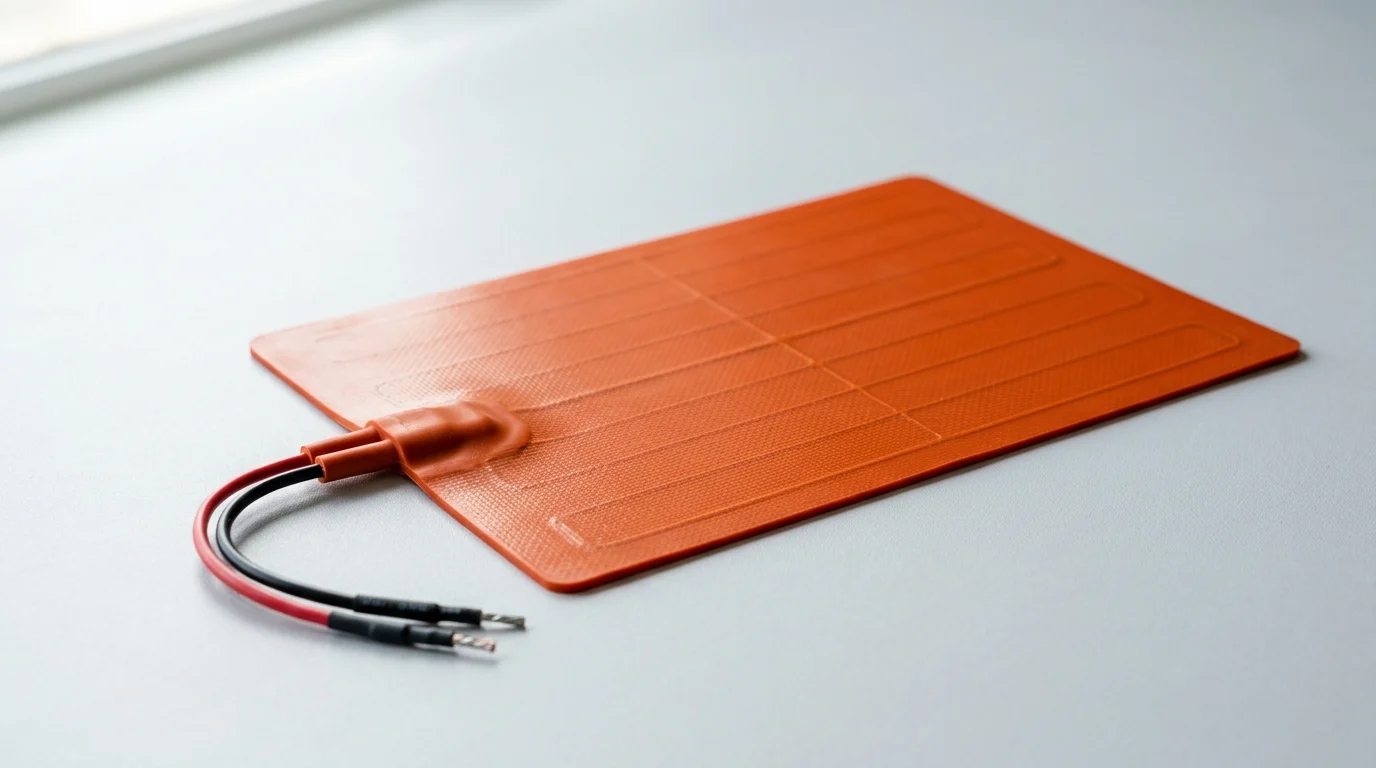 Jingwei Heat silicone rubber heater with integrated PID controller — for chemical plant pipe preheating and freeze protection.
PID Control: Why On-Off Thermostats Are Inadequate for Chemical Process Temperature Maintenance
An on-off thermostat — the simplest and least expensive temperature control method — turns the heater on when the pipe temperature drops below a lower setpoint and off when it rises above an upper setpoint. The temperature oscillates between these two setpoints, typically with a 5-10°C deadband. For freeze protection (maintain above 5°C), this oscillation is acceptable — the pipe never reaches 0°C. For chemical process temperature maintenance — where the fluid viscosity, reaction rate, or crystallization temperature depends on the pipe-wall temperature — a 5-10°C oscillation is not acceptable. A PID (proportional-integral-derivative) controller modulates the heater power continuously to maintain the pipe-wall temperature within 1-2°C of the setpoint. The initial cost premium for PID control over on-off control is $200-400 per control channel, but the process-quality benefit — consistent fluid viscosity, consistent reaction residence time, consistent product quality — justifies the premium for any application where the pipe temperature affects process performance.
Jingwei Heat’s silicone rubber heaters with integrated controllers include PID temperature control as standard, with RTD or thermocouple temperature sensors embedded in the heater for direct pipe-surface temperature measurement — more accurate than inferring temperature from heater electrical resistance, which varies with silicone aging.
Hazardous-Area Certification: ATEX/IECEx Requirements for Chemical Plant Heater Installations
Chemical processing plants contain areas classified by the probability and duration of flammable atmosphere presence. Installing an uncertified electric heater in a classified area is a regulatory violation that will be flagged during the plant’s next safety audit and may result in a shut-down order until the non-compliance is corrected. Understanding the zone classification and the corresponding heater certification requirements is essential before specifying a pipe-heating system.
ATEX Zone classification (IEC 60079 explosive atmosphere standard): Zone 0: flammable atmosphere present continuously or for long periods (above 1,000 hours per year) — heaters with Ex ia (intrinsically safe) protection are required. Zone 1: flammable atmosphere likely to occur in normal operation (10-1,000 hours per year) — heaters with Ex d (flameproof enclosure) or Ex e (increased safety) protection are typical. Zone 2: flammable atmosphere unlikely in normal operation and of short duration if it occurs (below 10 hours per year) — heaters with Ex n (non-sparking) protection are acceptable. Most chemical-plant pipe racks and process areas are classified as Zone 2; areas immediately around storage-tank vents, pump seals, and sampling points may be Zone 1.
The heater certification must cover the complete assembly — not just the heating element. The silicone rubber heater body, the terminal box, the cable gland, the temperature sensor, and the controller (if mounted in the hazardous area) must all carry the appropriate ATEX/IECEx certification for the zone. A heater with a certified element but an uncertified terminal box will not pass the installation inspection. The certification documentation must include: (1) the EC-Type Examination Certificate issued by a notified body (e.g., Baseefa, SGS, TUV), (2) the manufacturer’s Declaration of Conformity, (3) the installation and maintenance instructions specifying the permitted ambient temperature range, the maximum surface temperature class (T-class, typically T3 for 200°C or T4 for 135°C maximum surface temperature), and the electrical parameters (voltage, power, current).
The temperature classification (T-class) is the specification that determines where the heater can be installed. The heater’s maximum surface temperature must be below the auto-ignition temperature of the flammable substances present. For a chemical plant handling ethanol (auto-ignition temperature 363°C), a T3-rated heater (200°C maximum) is acceptable. For a plant handling carbon disulfide (auto-ignition temperature 90°C), a T6-rated heater (85°C maximum) is required — and a standard silicone rubber heater cannot meet this temperature limit at any useful watt density. In such cases, a different heating technology (steam tracing, hot-water jacketing) must be used. Jingwei Heat provides ATEX/IECEx certified silicone rubber heaters for Zone 1 and Zone 2 installations with T3 or T4 temperature classification — the most common requirements for chemical-plant pipe heating applications.
Installation Best Practices: Avoiding Thermal Fatigue, Moisture Ingress, and Mechanical Damage in Industrial Pipe Heating Systems
Three failure modes account for over 80% of the silicone rubber heater failures I investigate in the field. Each is preventable through correct installation practice, and each produces a different failure signature that points directly to the root cause. Understanding these failure modes before installation avoids the situation where a $3,000 heater system fails after 18 months because of a $50 installation error.
Thermal fatigue from on-off cycling accounts for approximately 40% of premature heater failures. Each time the heater cycles from ambient temperature to operating temperature, the silicone elastomer expands by approximately 0.02% per degree Celsius — a 150°C temperature rise produces 3% linear expansion. The heater is mechanically constrained by the pipe surface (it is strapped tight), so the thermal expansion creates internal shear stress in the elastomer that accumulates with each cycle. Silicone rubber heater elastomers are tested for tensile strength and elongation per ASTM D412 — the standard test method that determines the tear resistance and elongation-at-break properties that govern how many thermal cycles the elastomer can withstand before delamination initiates. A heater cycling 20 times per day accumulates 7,300 cycles per year. After 30,000-50,000 cycles — approximately 4-7 years — the accumulated shear stress causes delamination: the fiberglass-reinforced silicone layers separate, creating internal air gaps that become hot spots because the heat from the resistance wire cannot conduct through the delaminated area. The failure signature is a localized burn mark on the heater surface at the delamination location. The prevention is specifying a PID temperature controller that modulates the heater power rather than cycling it fully on and off — reducing the thermal-cycle amplitude from 150°C to 5-10°C and extending the heater’s thermal-fatigue life from 4-7 years to 15-20 years.
Moisture ingress through the terminal-box seal accounts for approximately 25% of failures. Outdoor pipe-heating installations in cold climates are exposed to rain, snow, freeze-thaw cycles, and condensation. Water enters the terminal box through a failed cable-gland seal — typically because the gland was overtightened during installation, cracking the silicone sealing grommet, or because the installer used a metric cable gland on an imperial cable (or vice versa) and the resulting gap admitted moisture. Once water enters the terminal box, it tracks along the power-lead insulation to the heater termination point, where it causes electrochemical corrosion of the resistance-wire-to-power-lead crimp connection. The corrosion increases the connection resistance, creating a hot spot that eventually melts the solder or burns through the crimp. The failure occurs 12-24 months after installation — long enough that the installer’s error is forgotten. I specify an IP66 or IP67 rated terminal box for outdoor installations, with a cable gland matched to the power-lead diameter (not the nearest available size), and I test the gland seal with a low-pressure air test (0.2 bar, soap-bubble leak detection) before commissioning the heater. The air test takes 5 minutes and can be performed with a bicycle pump and a soap solution — a $5 check that prevents a $3,000 heater failure.
Mechanical damage during maintenance accounts for approximately 15% of failures. Silicone rubber heaters installed on pipe racks are vulnerable to damage from maintenance activities — a mechanic stepping on the heater, a pipe wrench dropped onto the heater surface, or an insulation jacket installed over the heater without the protective metal over-sheath. The damage may not be immediately visible — a small cut in the silicone outer layer exposes the internal fiberglass reinforcement to moisture, which wicks along the fibers and reaches the resistance wire within weeks. I specify a protective stainless steel over-sheath (0.3-0.5 mm thickness, secured with band clamps) over every outdoor pipe-heater installation. The over-sheath adds $20-40 to the installation cost and protects the heater from the maintenance activities that are inevitable in an operating chemical plant. A heater without an over-sheath is a heater that will be damaged.
Frequently Asked Questions
Q1: How is the heater secured to the pipe, and does it require thermal compound?
Silicone rubber heaters are secured with adjustable straps or adhesive-backed silicone that bonds directly to the pipe surface. Thermal compound (silicone-based heat-transfer paste) is recommended for applications above 1.5 W/cm² to fill microscopic air gaps between the heater and pipe that create thermal resistance. For freeze-protection applications below 1.0 W/cm², the heater’s flexibility and strap tensioning provide adequate thermal contact without compound. The heater must overlap the full pipe circumference — a heater that covers only 270 degrees of the pipe will leave a cold spot on the unheated segment that can freeze even with the heater operating.
Q2: What electrical supply and control-panel requirements are needed?
Silicone rubber heaters are available in standard voltages: 120V, 240V single-phase for smaller applications (up to 2 kW), and 240V or 480V three-phase for larger installations. The control panel typically includes: main circuit breaker, heater contactor, PID temperature controller, high-limit safety thermostat (set 20-30°C above the process setpoint), and alarm relay for high-temperature, low-temperature, and sensor-failure conditions. For hazardous-area installations, the control panel must be located in the non-hazardous area, with intrinsically safe barriers or explosion-proof conduit seals at the hazardous-area boundary.
Q3: Can silicone rubber heaters be used on plastic and lined pipes?
Yes — with watt-density derating. Plastic pipes (PVC, CPVC, PP, PVDF, PTFE) and rubber-lined or glass-lined steel pipes have maximum allowable surface temperatures of 50-90°C (depending on the material) and lower thermal conductivity than bare steel. The watt density must be derated to 0.3-0.8 W/cm² to keep the heater surface temperature below the pipe material’s maximum, and thermal compound is mandatory to maximize heat transfer and minimize the temperature gradient between the heater and the pipe wall. For PTFE-lined pipe — common in chemical plants handling corrosive fluids — the maximum continuous surface temperature is typically 200-260°C, giving more flexibility in watt-density selection than PVC or PP.
Q4: What is the typical lead time for custom-sized silicone rubber heaters?
Standard catalog heaters in common sizes (50 mm to 300 mm width, 500 mm to 3,000 mm length, 120V or 240V) ship within 5-7 working days. Custom-sized heaters — any dimensions outside the catalog range, custom watt density, custom voltage, integrated temperature sensors, or ATEX/IECEx certification — require 15-25 working days including: design and drawing approval (2-3 days), material preparation (3-5 days), manufacturing (5-10 days), testing and certification documentation (2-3 days), and shipping (3-5 days). Rush orders with a 30% surcharge can reduce the lead time to 10-15 working days. For planned plant turnarounds, I recommend ordering heaters 4-6 weeks before the shutdown to allow time for any drawing revisions or certification issues.
Q5: How is the heater electrically connected and what safety interlocks are required?
The heater is connected via a flexible power lead (silicone-insulated, 1-3 meters length standard, custom lengths available) terminated in a junction box mounted near the heated pipe section. The junction box must be rated for the area classification — IP65 minimum for outdoor installation, IP66/IP67 for washdown areas. A high-limit safety thermostat (manual-reset type, set 20-30°C above the process setpoint) must be wired in series with the heater contactor coil — if the PID controller fails in the “heater on” state, the high-limit thermostat opens the contactor and removes power from the heater. The high-limit thermostat must be independent of the PID controller — a separate sensor, a separate relay, a separate power-disconnect path — because the single most dangerous failure mode is a controller failure that leaves the heater energized. For hazardous-area installations, the safety interlock circuit must also be certified for the zone classification.
Q6: How should silicone rubber heaters be stored as spare parts?
Silicone rubber heaters are chemically stable in storage but mechanically vulnerable to kinking and creasing. Store heaters flat (not folded or rolled tightly) in their original packaging at 10-30°C and below 60% RH. Do not stack heavy objects on stored heaters — the weight can permanently deform the silicone and create thin spots in the heating element. The shelf life of a properly stored silicone rubber heater is 5-10 years — the limiting factor is gradual hardening of the silicone elastomer (cross-linking continues slowly at room temperature). Before installing a heater that has been in storage for more than 3 years, measure the insulation resistance at 500V DC — it must exceed 10 megohms. A heater with insulation resistance below 10 megohms should not be installed because the degraded insulation creates a shock hazard and may trip the ground-fault protection circuit.
About the Author
Jake has 10+ years of experience in silicone rubber heater design and manufacturing at Jingwei Heat. I have supplied heating solutions to chemical plants, oil refineries, and food processing facilities in cold-climate regions including Russia, Canada, Scandinavia, and Northern China. Explore our silicone rubber heaters with integrated controllers and full product range.
Post time: Jul-07-2026